 strokr
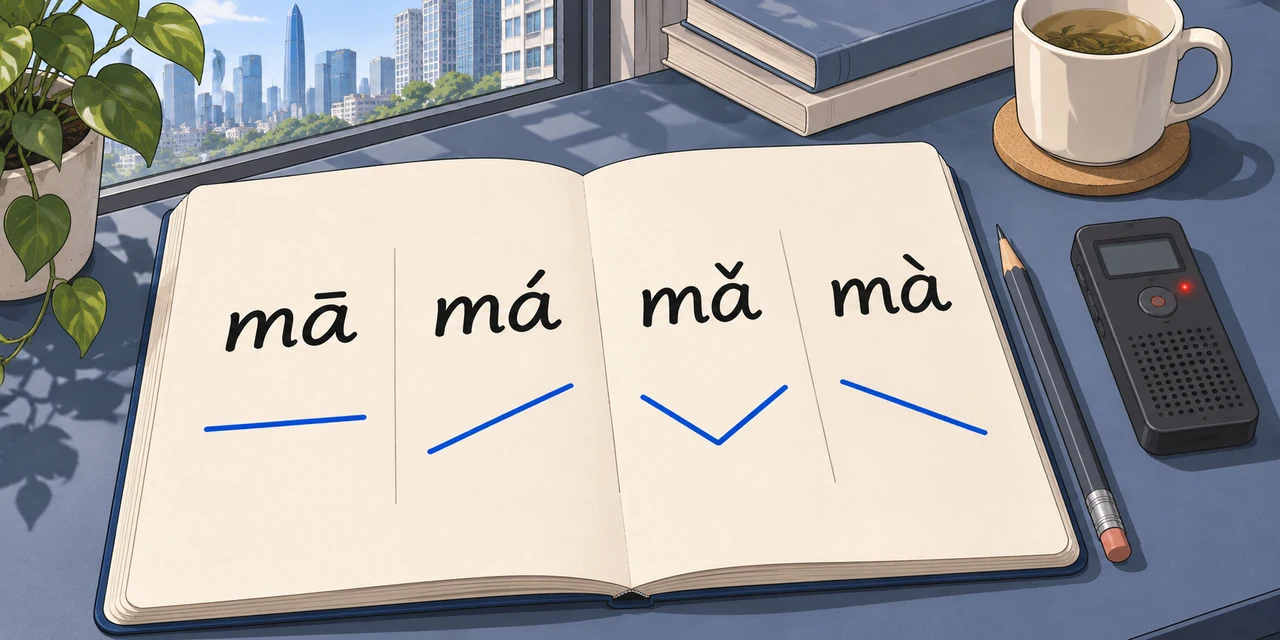
How Pinyin Represents Mandarin Sounds
When you first open a Chinese book or street map, characters like 中文 or 山 give no obvious clue about how they sound. Pinyin (拼音, pīnyīn, literally "spelling sounds") solves that problem. It is the standard system for writing Mandarin pronunciation with the Latin alphabet.
Before reading your first syllable, keep two ground rules in mind:
- A character usually represents one syllable. The word 中文 (Chinese language) has two characters and two syllables, and .
- Pinyin follows its own spelling rules. Letters such as
q,x,zh, andcrepresent specific Mandarin sounds. Pair the spelling with a recording as you learn each sound.
The Three Parts of a Pinyin Syllable
Every standard Mandarin syllable breaks cleanly into up to three pieces:
| Part | Role | Example in (山, mountain) | Example in zhōng (中, middle) |
|---|---|---|---|
| 1. Initial | The opening consonant that shapes the start of the syllable | sh- | zh- |
| 2. Final | The vowel core (sometimes followed by -n or -ng) | -an | -ong |
| 3. Tone mark | The pitch contour placed above the main vowel | ā (first tone, high and level) | ō (first tone, high and level) |
Some syllables have no consonant initial—for example, 爱 (, to love)—or begin with the helper letters y- and w-, as in 文 (wén, writing). Every full syllable, however, carries a tone.
The Four Tones and the Neutral Tone
In English, changing the pitch of your voice changes the mood of a sentence: "Really?" rises in surprise, while "Really." falls in certainty. The word itself stays the same.
In Mandarin, pitch can distinguish words, just like a vowel or a consonant. For example, means mother and means horse.
Linguists map Mandarin pitch on a simple 1-to-5 voice scale, where 5 is the top of your natural speaking voice (never a shout or falsetto), 3 is your relaxed middle pitch, and 1 is the bottom of your comfortable speaking range.
Pitch within your speaking range
- 5
- High
- 3
- Middle
- 1
- Low
First Tone: High and Level (5 → 5)
The flat bar shows a steady pitch. Keep your voice high and level.
Listen and repeat
- 妈mother
- 山mountain
- 天sky / day
Second Tone: Rising (3 → 5)
The rising mark follows the pitch. Start around the middle of your range and glide up.
Listen and repeat
- 麻hemp
- 文writing
- 茶tea
Third Tone: Dipping Low (2 → 1 → 4)
The caron shows the dip you may hear in isolation. In connected speech, the third tone often stays low.
Listen and repeat
- 马horse
- 好good
- 水water
Fourth Tone: Crisp and Falling (5 → 1)
The falling mark follows the pitch. Start high and let your voice fall briskly.
Listen and repeat
- 骂to scold
- 大big
- 是to be
Neutral Tone: Light and Unmarked
The vowel has no tone mark. Say the neutral syllable lightly and briefly. Its pitch depends on the preceding tone. In the examples below, colour marks the neutral syllable.
Listen and repeat
- 妈妈mom
- 爸爸dad
- 谢谢thank you
Interactive Practice: Compare and Identify the Four Tones
Reading about pitch only gets you halfway; training your ear comes from hearing the four contours side by side and testing yourself without looking at the tone mark. In the exercise below:
- Compare the four tones of ma (mā, má, mǎ, mà) and follow the shape of each pitch contour.
- Test your ear. Play the mystery recording and choose the curve that follows its pitch. Next plays the following recording, and you can replay it any time.
1 · High and level
妈mother2 · Rising
麻hemp3 · Low or dipping
马horse4 · Falling
骂to scold
Can you hear the difference between tones 2 and 3?
Both can rise at the end. Listen to how each syllable starts.
- Tone 2 (, ) starts around the middle of your range and rises.
- Tone 3 (, ) drops lower before any rise.
First Consonant Sounds
Play each example and listen for the highlighted letters at the start. Repeat the whole syllable, then compare the neighbouring sounds.
Unaspirated and Aspirated Pairs
Hold your hand just in front of your lips. Try each row and feel the extra puff of air on the aspirated sound. The final and tone match within each pair so you can focus on the first sound.
b
unaspirated
Like the p in spun.
- 爸dad
p
aspirated
Like the first p in pop.
- 怕to fear
d
unaspirated
Like the t in stop.
- 到to arrive
t
aspirated
Like the first t in top.
- 套a set
g
unaspirated
Like the k in sky.
- 哥older brother
k
aspirated
Like the k in kite.
- 科subject
The Smile Series
For j, q, and x, rest your tongue tip behind your lower teeth and lift the middle of your tongue toward the hard palate. Start with the tongue shape you use for an English ee.
j
Start gently with your tongue tip down.
- 叫to be called
- 家home
q
Use the same position as j and release a puff of air.
- 请please
- 七seven
x
Let air hiss softly over the raised middle of your tongue.
- 谢谢thank you
- 小small
The Retroflex Series
For zh, ch, sh, and r, raise the tip of your tongue slightly back toward the ridge behind your upper teeth. Play and in turn to hear how the release changes.
zh
Hold your tongue tip slightly back. Release gently.
- 中middle
- 这this
ch
Use the same position as zh and release a puff of air.
- 茶tea
- 吃to eat
sh
Let air flow past your raised tongue tip.
- 山mountain
- 书book
r
Use your voice with your tongue tip slightly back.
- 人person
- 日sun / day
The Front Series
For z, c, and s, keep the tongue tip near the front teeth. Try the English endings in kids and cats to get a feel for the first two sounds.
z
Think of the ending of kids.
- 再见goodbye
- 字character
c
Think of the ending of cats, with a puff of air.
- 菜vegetable / dish
- 次occurrence
s
Think of the start of sun.
- 三three
- 四four
Finals, Tone Placement, and the Hidden "ü"
Pinyin uses six vowel letters. Their sounds depend in part on the syllable they spell.
a · o · e · i · u · ü
a— Open ah as in father (妈 , 大 ).o— Rounded aw/oh (我 , I / me, pronounced with a slight w glide: uo).e— Unrounded throat vowel, similar to u in fur or e in her without the English r (喝 , to drink; 热 , hot). When paired withiory(也 , 谢谢 ), it shifts to a crisp eh as in yes.i— Usually ee as in see (你 , 一 ). Afterzh,ch,sh,r,z,c, ors, keep your tongue near the position of the initial and add voice. Compare and with nǐ.u— Rounded oo as in flute (书 , book; 不 , not).ü— Say "ee" (i) with your tongue forward, then round your lips as if whistling without moving your tongue back. Example: 女 (, woman).
Two Spelling Shortcuts to Know on Day One
- Place the tone mark on
awhen present, otherwise onoorewhen present. Compare , , and . Withiuorui, mark the second vowel, as in (six) and (correct). A single vowel takes the mark itself. - Pinyin drops the dots on
üin spellings such asju,qu,xu, andyu. The vowel keeps its rounded, front pronunciation.- 去 (to go) is written , pronounced with rounded
ülips. - 月 (moon / month) is written , starting with the
üsound. - After
nandl, bothuandüexist, so the dots remain visible to tell words apart: 路 (, road) vs. 女 (, woman).
- 去 (to go) is written , pronounced with rounded
Tones in Living Speech: Tone Changes You Will Hear Immediately
When syllables join together in real conversation, two natural pitch adjustments make speech smoother and easier on the throat:
1. Two Third Tones in a Row (3 + 3 → 2 + 3)
In a phrase like nǐ hǎo, two third tones meet. The first syllable takes a rising contour like the second tone.
- Written Pinyin: 你好 · (hello)
- How you actually say it: ní hǎo (rising on 你, dipping low on 好).
- Note: Standard Pinyin keeps the original dictionary tone marks (
nǐ hǎo) so you always recognize the underlying words.
2. The Shifting Tone of 不 (bù → bú)
The word 不 (not) normally has a falling fourth tone, as in 不好 (, not good). Before another fourth tone in these phrases, it takes a rising second tone.
- 不对 (incorrect) · . Listen for bú duì (rising + falling).
- 不客气 (you’re welcome) · . Listen for bú kèqi (rising + falling + neutral).
Quick Self-Check: Read Your First Everyday Phrases
Before moving on to writing characters, read these four everyday words aloud. Use the checklist in the right column to verify your tongue position and tone contour:
| Word | Pinyin | Meaning | What to Check When You Say It Aloud |
|---|---|---|---|
| 中文 | Chinese language | Curled tongue tip on zh-; hold zhōng high and level (5 → 5), then lift wén smoothly upward (3 → 5). | |
| 你好 | hello | Two third tones meet (3 + 3): let nǐ rise like a 2nd tone (ní), then drop hǎo low into your chest. | |
| 谢谢 | thank you | Flat "smile" tongue on x- (tip behind lower teeth). Drop xiè sharply (5 → 1) and let the second xie trail off short and light. | |
| 不客气 | you’re welcome | Because 客 (kè) is 4th tone, lift 不 to a rising 2nd tone (bú), drop crisply on kè (with a breathy k), and tap lightly on neutral qi (smile q with a puff of air). |
Once you can hear and trace the four tones, you are ready to put pen—or finger—to paper. In the next lesson, Chinese Stroke Order: The Core Rules of Handwriting, you will see how a handful of directional habits make every Chinese character feel natural to write.